

The aim of succession planning is to help ensure businesses can continue to run uninterrupted and smoothly should a key employee retire, pass away or move on to a new opportunity. Succession planning may entail training employees in other roles and acts as a contingency plan for emergencies that may occur within a business.
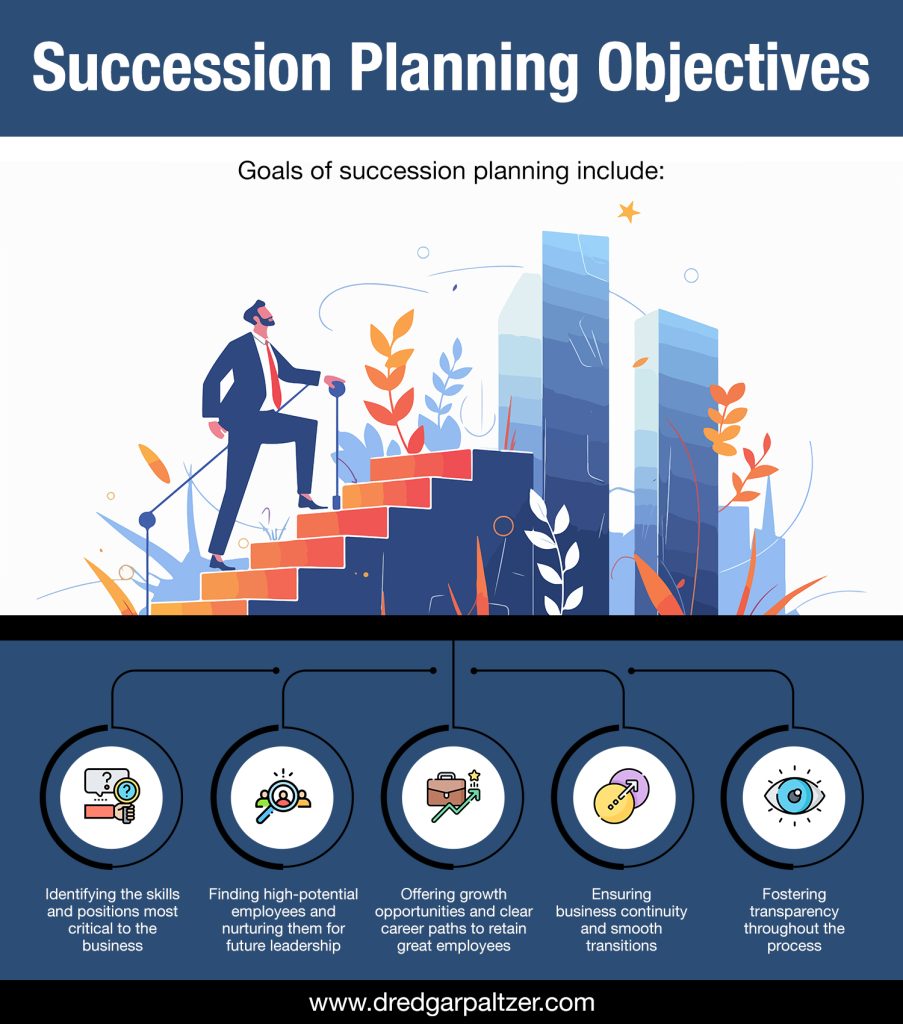
Getting Started
A succession plan should assess every leader’s skillset to identify potential replacements both outside and within the company. This allows for employee training as necessary so that these individuals are prepared to take control when the time comes.
For family-owned companies and small businesses, succession planning often entails training the next generation, whereas larger enterprises may train mid-level employees to take over higher-level positions in the future. In very large, established companies, the CEO and board of directors usually oversee the succession planning process.
Some businesses create more than one succession plan. For example, a long-term succession plan could help the organisation manage leadership changes, while an emergency succession plan could account for a situation where a key leader unexpectedly needs to be replaced.
Preparing Employees
As part of succession planning, leaders should identify the knowledge, skills and practices important to retain and move employees to the necessary positions accordingly. This process may include developing talent (through training, increased responsibility or challenging work experience), identifying leaders and leadership development. When an employee is identified as being a potential future leader, a detailed succession path can be created that incorporates contingency plans for either unexpected or planned open roles.
Succession Planning Challenges
Common obstacles in succession planning include resistance to change (among employees or leaders), lack of senior leadership buy-in and limited resources. Inadequate metrics and data can also cause problems, as proper succession planning relies on these things; for example, performance evaluations and talent assessments can be vital in identifying the potential leaders of the future.
The Benefits of Succession Planning
Succession planning experts, such as Edgar Paltzer, know there are many important benefits of succession planning. As well as ensuring business continuity, the process can help mitigate talent shortages by enabling organisations to develop and keep high-potential employees. It can also promote employee engagement and retention by showing that the business is committed to supporting employees’ career development, thereby boosting loyalty and motivation.
Succession planning facilitates knowledge transfer, too, ensuring crucial expertise and information are not lost during transitions, and drives the business’s growth goals by responding to changing market demands and supporting innovation.